
Search Kingman County Land Records
An address or owner name opens the door. The CAMA public parcel route returns the parcel key. It also gives the legal description for a tract in Kingman County. From there the tax form widens the search. It accepts a parcel number, owner or taxpayer name, street, subdivision, block and lot. Section, township, and range work too. Deeds, plats, mortgages, and releases live elsewhere. Those conveyance records sit with the Register of Deeds. Carry the exact tract details and party names there.
For a visual check, the ORKA map lays parcel lines over the county. Treat its lines as reference, not proof of a boundary. In the same way, a CAMA owner display is not a deed. The name on a tax bill is not always the title owner. Note the source and update date beside every property records fact you keep.
- Search CAMA or the tax form with the best known address or name.
- Save the parcel key and legal description exactly as shown.
- Inspect the current and historical tax route for the same tract.
- Use ORKA for parcel context and the recorded plat for legal geometry.
- Inspect or request specifically identified instruments from the Register of Deeds.
Kingman County Record Custodians
Three county functions carry the main trail. The Register records instruments but performs no title research. The Appraiser maintains parcel identity, ownership display, classification, value, and mapping data. A Treasurer-linked tax module covers current and historical tax searches. The County Clerk handles levies, abstracts, elections, administration, and some state forms, yet it never replaces the deed or parcel custodian for land record questions.
Kingman County Register of Deeds
130 N. Spruce St., P.O. Box 461
Kingman, KS 67068
620-532-3211 / 620-532-5068
Kingman County Appraiser
130 N. Spruce St.
Kingman, KS 67068
County contact page
Kingman Tax Information Module
Online county tax route
Current and history searches
Public web access
Kingman CAMA Public Access
The CAMA entry page presents registered-user fields alongside a Continue as Public User control. The login screen shows how these public and registered routes split. The Appraiser's stated duties cover parcels, ownership display, legal-description mapping, classification, valuation, and CAMA/GIS data.
A portal update date is dynamic, not the start of historic coverage. Save it with any result and compare a recent owner change against the recorded deed. The county warns that its data and maps come from several sources. They change over time. They are not legal documents.
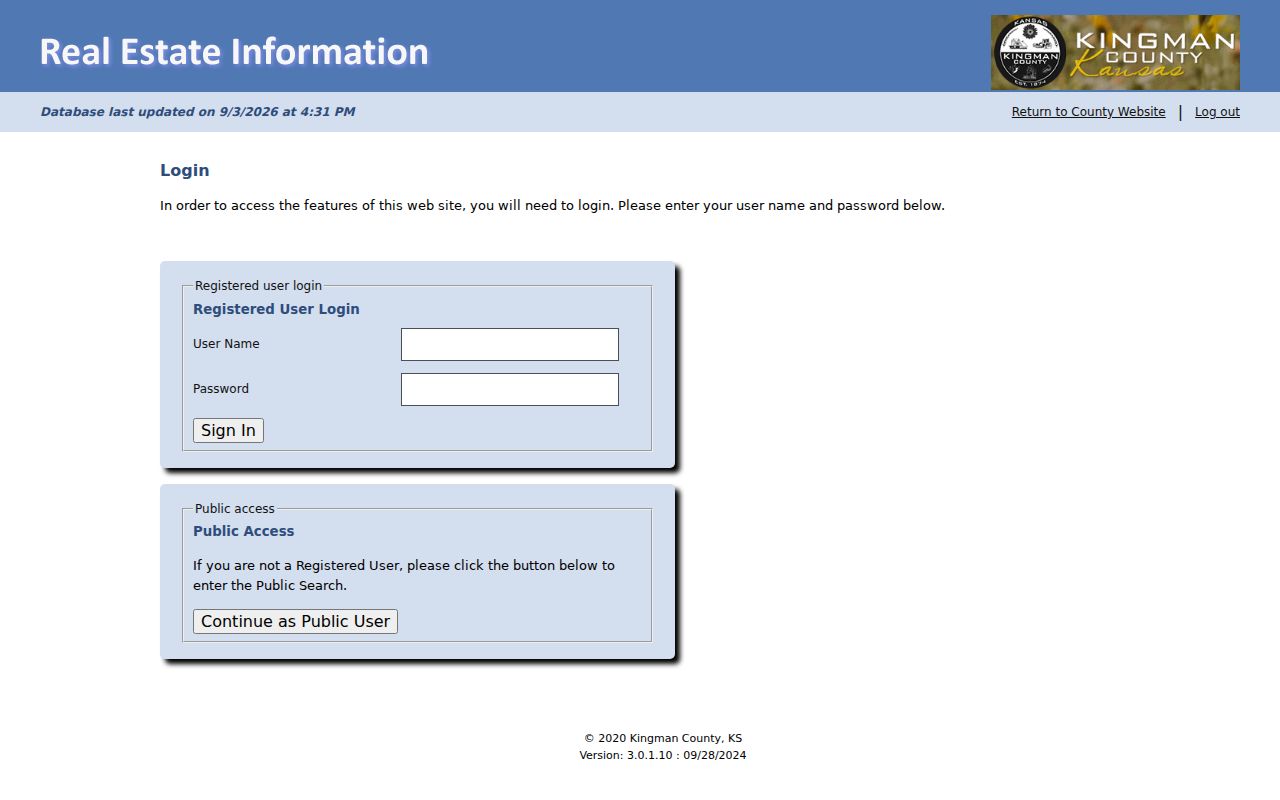
The public-user control is the relevant starting point for a basic parcel lookup.
Kingman Tax Search Choices
The tax form accepts Real Estate, Personal Property, Oil, Gas, Trucks, Minerals, and State Assessed Utilities. It also offers owner or taxpayer name, street, parcel, subdivision, block and lot, legal location, lease name, tax years, and Quick Ref. Current-owner, taxpayer, and both-name modes prevent a common identity mix-up. Use Real Estate for land and improvements. Mineral and surface interests may follow distinct paths. Current-tax and taxes-due filters are available as search choices.
| Field group | Useful inputs | Purpose |
|---|---|---|
| Name | Owner, taxpayer, or both | Find likely accounts |
| Address | Street number and name | Start from a situs |
| City land | Subdivision, block, lot | Match an addition |
| Rural land | Section, township, range | Match a rural tract |
The official tax form displays these criteria.
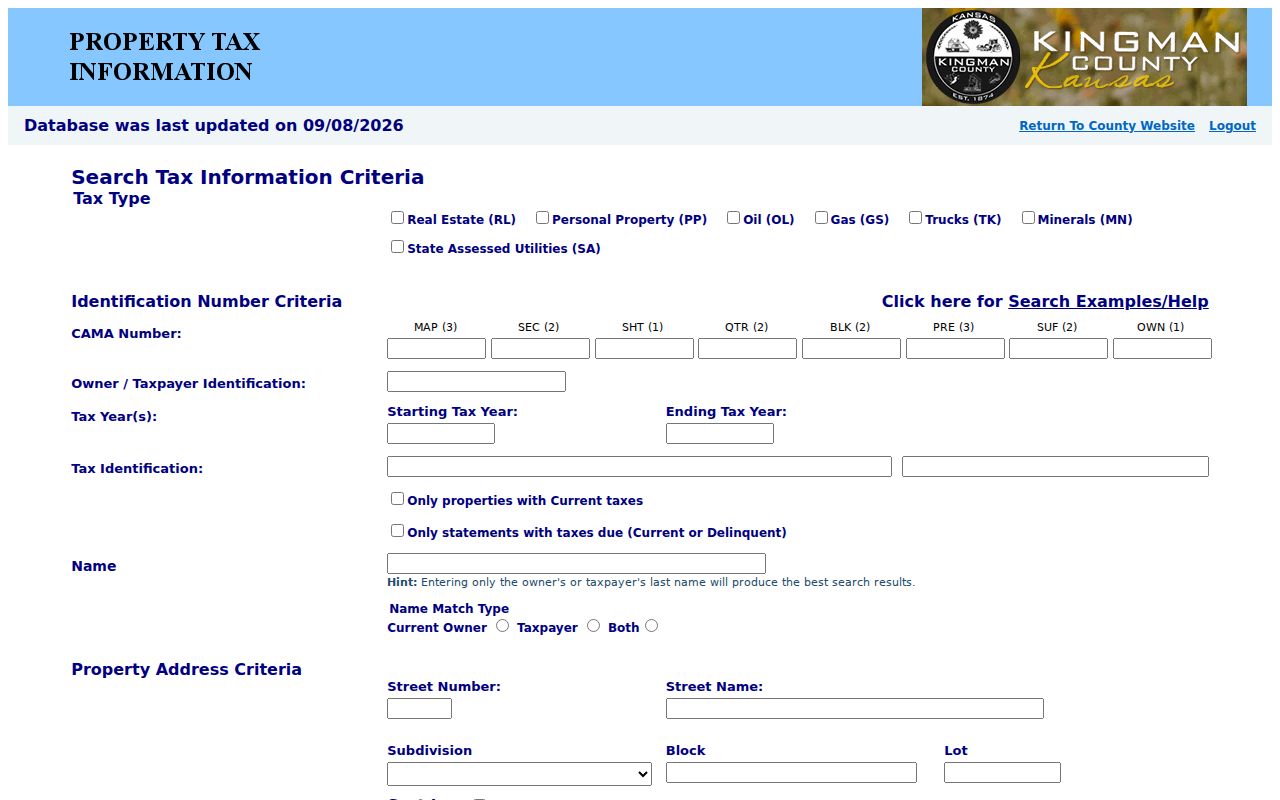
When a street search comes up empty, the form's legal-location keys give Kingman County users a reliable second route.
Kingman Deeds Stay Offline
Kingman publishes no online grantor-grantee index, and no starting year or image cutoff is stated. The Register offers office inspection and copies of identified records. Give the grantor, grantee, instrument type, book and page if known, and tract description. The office conducts no open-ended title search.
Recorded instruments include deeds, mortgages, releases, oil-and-gas leases, plats, surveys, tax liens, and powers of attorney. Military discharges are also recorded, subject to access rules. The office FAQ lists thirteen dollars for a certified copy. The current fee should be checked. The Register page is the source for contact and request instructions.
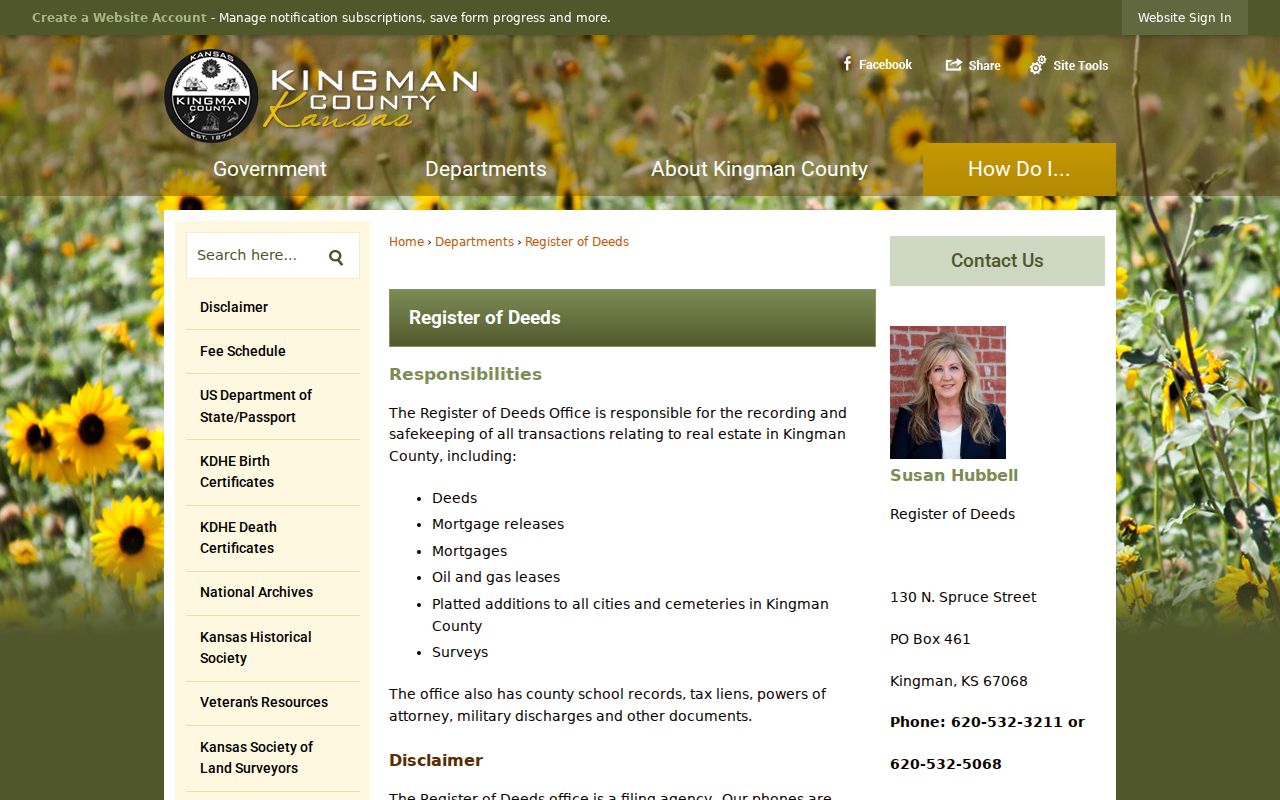
This office route remains essential because no supported web deed index was located.
Kingman County Record Types
No single result is the full file. Recorded conveyances establish the filed transfer, while CAMA maintains the working parcel roll. Tax records follow charges and status. Plats and surveys carry geometry, and permits document proposed or approved work. Court orders may explain foreclosure, quiet title, partition, or an estate, but match them to the later recorded instrument before relying on either.
| Record Type | What It Documents | Kept By | Access |
|---|---|---|---|
| Deeds and releases | Transfers and filed interests | Register of Deeds | Office inspection or identified copy |
| Assessment | Parcel, owner display, class, value | Appraiser | CAMA public route |
| Tax | Current and history searches | Treasurer module | Public form |
| Plats and parcels | Recorded and mapped geometry | Register and ORKA | Office plus viewer |
| Permits | Land-use and project files | City or county planning | Forms and custodian request |
For the instrument trail, turn to Kingman County deed records. The exact legal description is the handoff key, not a loose name match; tax and map pages handle their own detail.
Kingman Plats and ORKA
The statewide ORKA experience combines parcel GIS, roads, imagery, and CAMA context. County-specific adjacency tools are not documented. The exact Kingman field schema is not documented either. Treat a parcel polygon as a lead. A survey or recorded plat settles any legal boundary question.
City parcels use lot, block, and addition. Rural land uses section, township, and range. Search subdivision labels such as Hillside Add, Replat, Norwich, Supp. Plat, or Cunningham Town Site. Then ask the Register for the relevant plat, replat, vacation, or easement. The ORKA support service identifies statewide map resources.
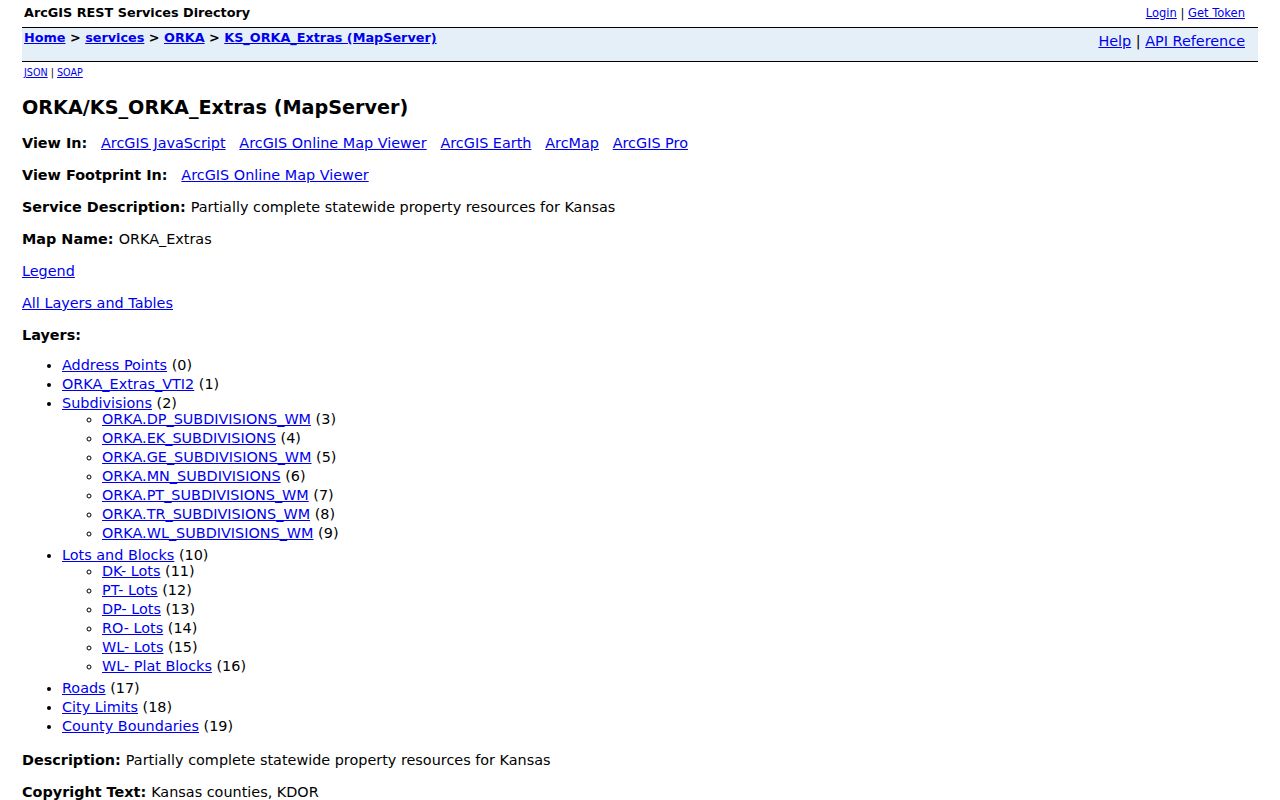
Service-level layers do not guarantee that every field is populated for Kingman County.
City and County Permit Files
County Planning/Zoning covers unincorporated land. Kingman, Cunningham, and Norwich keep separate municipal records within city jurisdiction. A ZIP code cannot establish which office controls. Confirm the parcel's situs and city boundary first.
The county's revised 2026 form asks about owner, contractor, and location. It also covers legal description, work, use, lot, and structure details. Applications are available at the courthouse or by PDF. Instructions target a decision within fourteen working days or an agreed extension. City systems differ, and the county offers no integrated permit-result database.
Kingman Assessment Rules
Kansas keeps three numbers apart. Appraised value, assessed value, and the tax levy each play a distinct role. All three appear in a Kingman County property record. Under K.S.A. 79-1439, residential property is assessed at 11.5 percent. Commercial and industrial property is assessed at 25 percent, and agricultural land at 30 percent of its economic-use value. These percentages are not mill rates.
Valuation notices are generally due by March 1, and a thirty-day equalization appeal period follows. Later county and Board of Tax Appeals steps carry deadlines of their own. Confirm the current calendar before acting. A property record can display a prior year's value.
Historic Kingman Property Clues
Old newspapers can rescue a stalled Kingman County property search. The county history source notes that Kingman Public Library holds county and city newspaper microfilm. The microfilm runs from 1884 to the present. Notices in those pages can reveal old addition names, sales, estates, plats, zoning hearings, and street references. That helps when a modern address fails.
A newspaper notice is still not a deed. Record its date and wording. Then confirm the event with the Register, the court, or the city custodian. The county publishes no online deed-book inventory or historic plat catalog. No courthouse-fire record gap appears in its history.
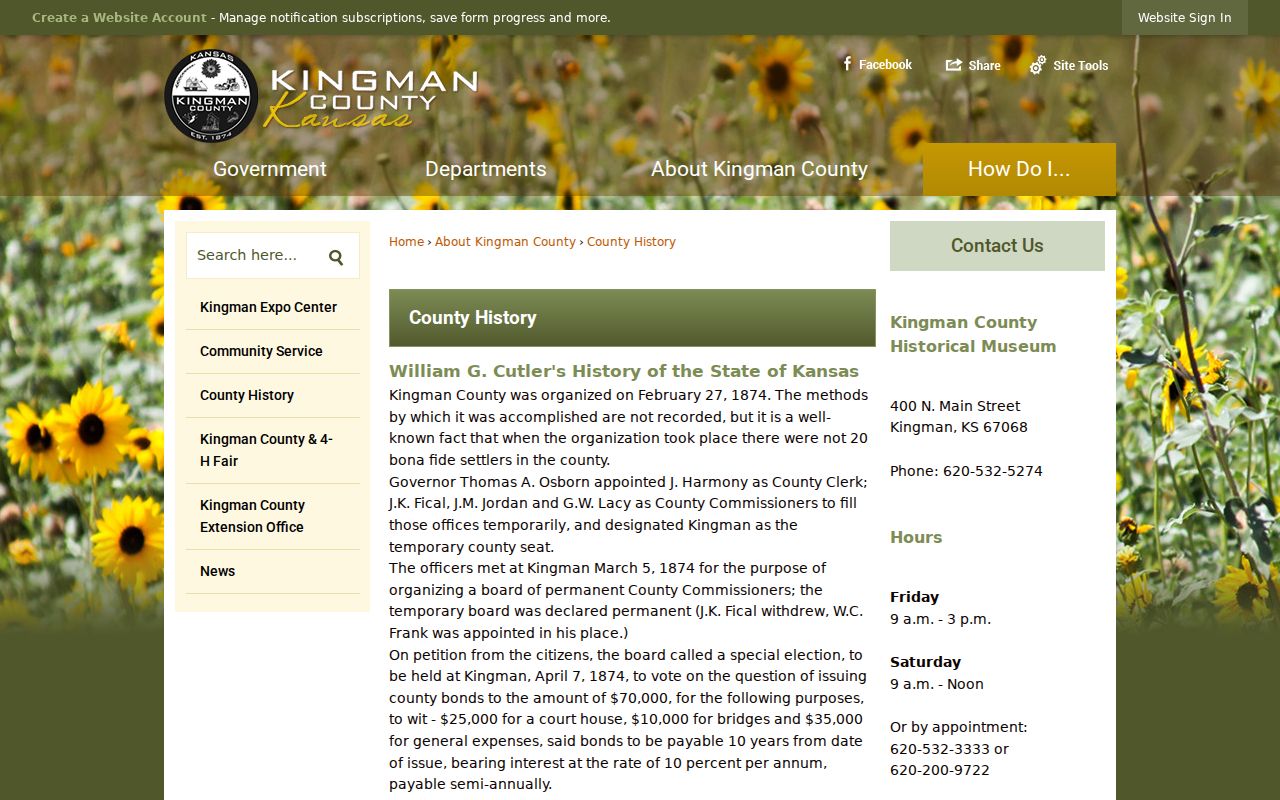
The microfilm bridges old names to official land records.
KORA Requests for Property Records
The Kansas Open Records Act applies. Under K.S.A. 45-215 through 45-223, a person may inspect and copy non-exempt existing records. A custodian may ask for contact details. Describe the record specifically. Some action is due by the third business day, though fees, review, or redaction can extend production. Name the parcel, instrument, party, or date range. An agency need not create a record, interpret a legal description, or research title, and the K.S.A. 45-221 exemptions plus K.S.A. 45-230 limits on commercial use of names and addresses still apply.
Kingman Tax Appeal Calendar
Valuation notices arrive by March 1. An equalization appeal then has thirty days. The informal meeting is generally completed by May 15, with a final determination by May 20. A Board of Tax Appeals filing is generally due within thirty days of that result. A statutory single-property appraisal option runs on a separate sixty-day period. County certification follows in June.
Tax statements are generally mailed by December 15, with full or first-half payment due December 20 and the second half due May 10. Check the current dates before acting. The Appraiser handles value and class, the Treasurer-linked record handles the bill, and the Register can change neither.
Keep the paper trail. The valuation notice, parcel number, values, class, tax year, and appeal response belong together, and agricultural land takes economic-use value before its percentage applies, so a sale-price comparison can mislead. Assessment percentages are not tax rates.
Verify Kingman Property Findings
A sound result can be reproduced. Write down the official URL, the terms used, the tax year, the update stamp, the parcel key, the legal description, the source label, and the retrieval date. Label the image too. Note whether it came from CAMA, the tax module, ORKA, a city form, or an office page, because a portal entry screen is not a parcel result.
Compare Kingman County sources by function. Use CAMA for the working owner display, the Register for instruments, the tax module for tax queries, ORKA for map context, and planning offices for permits and zoning. Carry the case number to the deed file. This keeps a taxpayer, permit applicant, agent, or mailing contact from being mislabeled as owner of record.
Request the document when an index is not enough. A certified copy verifies the custodian's copy, a title opinion addresses legal interests, and a survey addresses boundaries. County staff can identify and copy records. They need not construct a title report.
Levy sheets live in the County Clerk archive. They can explain the taxing units behind a charge, but they cannot replace the parcel's tax statement. Planning and zoning minutes work the same way. They may document a hearing or a recommendation, yet they establish no permit, final ordinance, recorded plat, or title transfer. Label each record by its real function. When an online tool hides the image you need, note the document number or exact record class. The named custodian can arrange inspection or email, mail, or counter copies.
Kingman County splits its records across offices. Every handoff goes smoother when it carries the same parcel key and legal description. Treat the official office pages as the current authority whenever a vendor link, credential screen, fee, or form changes. Keep older notices only as dated context. A broken link does not prove a record is closed or gone. Call the custodian with the parcel and record type. Ask for the current inspection or copy channel.
Kingman Court and Tax-Sale Checks
Not every property event starts in the land index. Kansas district-court dockets can hold foreclosure, quiet-title, partition, lien-enforcement, probate, and tax-sale cases tied to a parcel. A docket entry is only a lead. Note the case number, caption, filing date, order, parcel clue, and any sale or redemption language. Move on after that. Then find the matching recorded notice, release, judgment, or deed.
Kansas delinquent-tax practice runs through published lists and later court action under K.S.A. 79-2302, 79-2303, and 79-2801. Kingman County keeps no stable online tax-sale catalog. Confirm any newspaper notice with the Treasurer, the district court, and the Register of Deeds. A published notice can precede redemption, dismissal, confirmation, or a later conveyance. The ending rarely matches the headline.
Estate cases deserve the same care. A will may name one beneficiary. Yet the recorded transfer can surface as a personal-representative deed, beneficiary deed, affidavit, or another instrument. The court order explains who held authority. The recorded deed and parcel update show what actually followed.
Kingman Records and Privacy
KORA access is broad but not absolute. Statutory exemptions, court sealing, criminal-investigative rules, and address-confidentiality protections can remove or replace sensitive details in Kingman County property records. A missing address proves nothing. A named person may still hold an interest in the land. A tax mailing address, likewise, does not mean the recipient lives at the parcel.
Use the fewest fields that answer the property question. K.S.A. 45-230 limits commercial use of public names and addresses, and Kansas voter-file rules carry their own restrictions. Voter, corrections, offender, and vital records are separate systems. Combining them to infer a private residence is unsound. Errors belong with the custodian. A data broker cannot correct the county roll, and an appraisal portal cannot rewrite a recorded deed. Keep the official source, retrieval date, and recording reference so a correction request lands precisely.
Limits of Kingman Property Records
Official Kingman County property records can carry you far. They show the owner on the tax roll, recorded grantees, tax search status, values, instruments, plats, and map context. They cannot do everything. A mailing address is not proof of residence, an old lien may already be released, and a GIS line is never a surveyed boundary. Not every interest appears online, either. Protected or substituted addresses can also be lawful. For a high-stakes claim, compare at least two record families, order a certified copy when certification matters, bring in a licensed surveyor for boundaries, and let a Kansas attorney or title professional interpret title.
Lawful use. Kingman County property records support due diligence, boundary research, estate work, and civic review. Never use owner information to target or harass anyone.