
Start a Kingman Property Search
Start with the Kingman County CAMA portal whenever you have an address or an owner name in hand. Its entry screen splits registered access from a public-user path. The tax search form accepts more search keys. It can recover a parcel number or legal description you did not know. Once the tract is pinned down, the Register of Deeds can locate a specifically described instrument. ORKA adds map context, though its lines are not a survey. Record the exact spelling, parcel key, legal description, and the date at every stage.
The CAMA public-entry screen puts the registered sign-in beside the public-user route. That route begins a Kingman County property search.
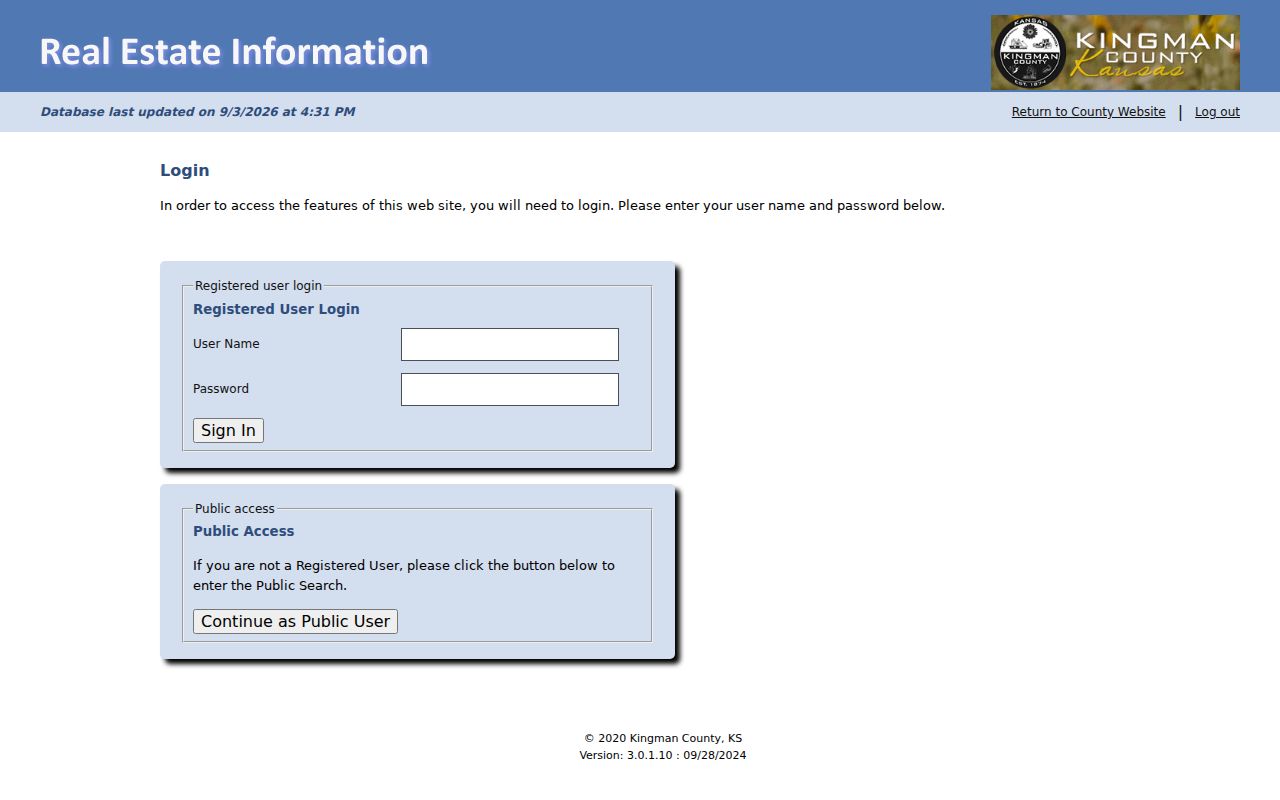
For a basic lookup, the public-user control is the right choice. Save the dynamic update notice along with the date of your search.
- Enter the street number and name, or continue through the CAMA public-user route.
- Record only the parcel, owner, situs, legal description, and value fields the result actually displays.
- Use the same parcel, owner, subdivision, or legal-location clue in the tax module.
- Carry the exact legal description to the Register of Deeds and the ORKA map.
- Inspect or order any identified recorded instrument needed for confirmation.
Kingman Address Search Fields
The Kingman tax search breaks an address into Street Number and Street Name. The number field takes five digits. The name field takes twenty-five characters. Direction and ZIP labels appear on the form, but the county exposes no working controls behind them. Begin with the bare street name. If a suffix like Street or Avenue blocks the match, shorten it and compare the likely results by legal description. The module also offers a current-tax route and a tax-history route, and it proves the criteria rather than the depth of the result card. Timestamp everything, because the tax roll keeps changing.
| Search clue | Captured format | Best use |
|---|---|---|
| Street Number | Up to 5 digits | Known situs |
| Street Name | Up to 25 characters | Address without ZIP |
| Parcel | Up to 20 characters | Cross-office handoff |
| Quick Ref | Up to 15 digits | Known tax key |
Owner and Taxpayer Searches
The tax form accepts an owner or taxpayer name up to thirty characters. The last name alone is the recommended first move. Its controls separate Current Owner, Taxpayer, and Both. That split matters. A taxpayer can receive a bill without being the grantee on the latest deed. Trusts, estates, and business entities only match their exact recorded spelling. If a common name floods the results, narrow it with a subdivision or a tax year. The Kansas Business Entity Search can confirm an entity's legal name and status. But a resident agent proves nothing about parcel ownership. Only the deed supplies that cross-check.
Note: A mailing address can reconcile records. But it does not establish where an owner lives.
Kingman Parcel and Map Keys
A property search can run on Tax Unit, Parcel, or Quick Ref. It can also run on MAP, SEC, SHT, QTR, BLK, PRE, SUF, and OWN. These short fields are picky about format and leading zeros. Copy each value exactly as an official result displays it. The parcel key is the bridge between the tax system and CAMA. It also links to Kingman County ORKA. It is not itself a deed or a legal description, though. When two systems seem to disagree, compare the full tract wording before trusting either one.
- Parcel or APN
- An administrative key connecting assessment, tax, and map data.
- Situs
- The physical location, distinct from the owner's mailing address.
- Owner of record
- The owner displayed by a source as of its update.
City Lots and Rural Land
Kingman County recording rules draw one bright line. City land is described by lot, block, and addition. Rural land runs on section, township, and range. The tax search supports both paths, so pick the vocabulary that fits the tract itself rather than its mailing city. A ZIP code settles nothing about jurisdiction. County Planning and Zoning handles unincorporated land, each incorporated city keeps its own permit and zoning files, and the parcel, tax, and deed records stay county-held.
Local Subdivision Search Clues
The subdivision selector preserves some telling local labels. Hillside Add, Replat appears there. So do Jett's and Reed's Refrontage, Norwich, Supp. Plat, Cunningham Town Site, and New Rochester (AKA Zenda). Labels like these bridge a modern address back to an older plat. They do not prove a date, a book and page, title, or a present boundary. Use the database spelling first, and inspect the full legal description when a long label gets shortened. Rochester and Zenda surface under several names. Carry any likely match to the Register of Deeds and request the original plat, replat, vacation, or correction by its exact name.
Choose the Kingman Tax Type
The public form offers Real Estate, Personal Property, Oil, Gas, Trucks, and Minerals. State Assessed Utilities appears there as well. For ordinary land, choose Real Estate. The separate mineral categories earn their place. Surface and mineral interests can travel on distinct records. Treat the filter as part of the parcel's identity. A business name may appear under personal property or trucks. That does not mean the business owns the land. Confirm against the real-estate parcel, the CAMA display, and the recorded deed.
Fix a Failed Property Search
An empty result often comes down to format. Drop the punctuation from a name, try the last name alone, shorten the street, and use the official subdivision label. For rural land, switch to section, township, and range. Keep any leading zeros in a known parcel key. The county publishes no official online Kingman deed index. If a portal path dead-ends, contact the Appraiser or view deeds at the courthouse. A KORA request can seek a specific existing non-exempt record, but the office need not build a report or run title research for you.
Record the Kingman Search Date
Online county data never sits still. Deeds post. Appraisal work moves forward, and tax years turn over. The tax module and the CAMA entry each display their own update date stamp. Those stamps describe the source at a moment, not permanent coverage dates. A careful note should preserve the date seen, the portal URL, the query used, and the selected tax year. It should also preserve any update stamp beside the result.
This matters most after a sale or correction. The latest recorded deed can name a new grantee. The working CAMA roll may lag in reflecting that person or entity. A tax history result can also show an earlier taxpayer without proving prior title. If the owner display and the deed differ, record both dates. Then ask the Appraiser or Register which update or instrument explains the gap. Never trust the newest screen alone.
For repeat work, save the precise subdivision label. Also save the chosen Current Owner, Taxpayer, or Both mode. A later user can then reproduce the Kingman County property search. The saved note shows whether the source changed.
What Kingman Search Results Show
The Appraiser handles parcel identity and ownership display. The office also maps legal descriptions, sets classification, and produces valuations. CAMA and GIS data round out the duties, so read only the fields the live card shows.
| Owner display | Working county owner name, subject to update |
|---|---|
| Parcel identity | Key linking assessment, tax, and map records |
| Legal description | City lot/block/addition or rural tract wording |
| Class and value | Appraiser-maintained assessment data |
| Tax query | Current, history, or taxes-due mode selected |
A recent deed may post before the roll changes. Compare the latest recorded grantee with the portal update, and remember that county maps and data stay subject to revision and are not legal documents.
Kingman Legal Description Handoffs
The legal description is the strongest bridge among Kingman County property records. City land may use a town site, addition, block, lot, replat, or refrontage. Rural ground leans on section, township, range, quarter, and tract wording. Copy the text exactly as shown. Dropping a part splits one chain into false matches.
A current street may fail to reach an older deed. Search by subdivision instead. A Register request can name the addition and lot, while rural ground calls for the legal-location fields first, with a deed comparison after, since a tract may cover only part of a section.
The county publishes no parcel-number legend. Never decode an APN by guess. Correction deeds need a forward check. The county FAQ says an old deed is not simply changed; a new deed is made. If CAMA, tax, and deed descriptions differ, search for a correction, re-recording, amended plat, vacation, lot split, or combination.
Kingman Tax History Filters
The tax history module lets you set a starting and ending tax year. It adds filters for current taxes and statements with taxes due. These controls narrow the query. They cannot tell you what the result card holds. Expect a balance layout, receipt image, payment history, and levy breakdown to depend on online depth the card may not show.
Search one parcel across several years when a past taxpayer matters. Label each name as owner, taxpayer, or both, depending on the mode you chose. Tax status changes with payment, redemption, correction, or legal action. Treat any status as time-bound.
Oil, Gas, and Minerals carry separate tax types, and Lease Name stands as its own field. Keep a mineral result apart from the surface estate unless a recorded instrument ties them together.
Each city adds a layer after the county search. Kingman publishes building and zoning resources along with codified zoning and subdivision rules. Cunningham routes paper building permits through City Hall and names a zoning administrator. Norwich gives City Hall contact information and a recent ordinance lead, but no parcel-level permit search. None of these city sources replaces CAMA, the tax system, or the Register of Deeds.
Near a city edge, confirm the situs first. County Planning and Zoning states that its authority reaches only unincorporated land. A city mailing address or ZIP does not prove a project fell under city rules. Ask the right planning custodian for the map, ordinance, minute, variance, or permit record by address, legal description, and date range.
A permit applicant may be an owner or an authorized agent. That role shows an application, not title. Compare the permit name against the owner display and the deed only when the property question requires it. Keep the source labels distinct.
For a formal request, state the parcel, the exact record type, the parties, and the date span. The Kansas Open Records Act covers existing non-exempt records. An office need not build a custom search or interpret results, though. The Kingman County Freedom of Information Coordinator is County Clerk Carol Noblit at 130 N. Spruce, Kingman, phone 620-532-2521. Send deed copy requests to the Register and parcel corrections to the Appraiser rather than assuming the Clerk holds every image.
Log failed queries too. The rejected spelling, tax type, subdivision choice, and date range can explain why a later search works. They also guard against the false claim that no record exists.
Compare Kingman Search Keys
An address is the fastest route to a current situs. An owner name can surface several tracts at once. A parcel key makes the cleanest handoff between systems, while a legal description reaches deeds and plats directly, so bring two clues together before deciding that two records describe the same land.
| Search Key | Best For | Where It Works | Watch Out |
|---|---|---|---|
| Address | One known tract | CAMA, tax, ORKA | Street variations |
| Owner name | Possible holdings | CAMA, tax, deed request | Trusts and same names |
| Parcel number | Exact handoff | Tax, CAMA, map | Format and zeros |
Not a title search. A Kingman County property search organizes public clues. It does not guarantee clear title or replace a Kansas title professional.