
Inside Kingman County Property Tax Records
Kingman County property tax records draw on two connected sources. The Appraiser discovers, lists, classifies, and values real property. The public Tax Information Module handles current and historical tax searches. Treat the search form and official guidance as the reliable guides to its result fields. The module's layout can change.
| Record item | Meaning | Official source |
|---|---|---|
| Appraised or use value | Value before the Kansas assessment percentage is applied | Kingman County Appraiser |
| Assessed value | Taxable value produced from the applicable classification percentage | Appraiser and Kansas valuation rules |
| Tax year and type | The year and category selected for the tax search | Tax Information Module |
| Current or historical status | The search scope, including optional current-tax or amount-due filters | Tax Information Module |
| Parcel and legal location | The identifier or land description tying the statement to the right tract | Tax search and CAMA |
An assessed value is not a sale price. Neither is a payment figure an appraisal. Keep every label tied to its source, and use the parcel number or legal description to confirm that records from the two systems describe the same land.
Kingman County Tax Search Fields Go Beyond an Address
Rural parcels often lack a clean street number. The Kingman County tax search form offers several other routes. Its range of fields is especially useful for matching a modern street reference to a subdivision or section description.
| Search route | Confirmed fields | Best use |
|---|---|---|
| Owner or taxpayer | Name; Current Owner, Taxpayer, or Both | Separate the owner display from the bill-to party |
| Street | Street Number and Street Name | Find a known situs without relying on ZIP |
| Parcel | Tax unit, Parcel, Owner/Taxpayer ID, Quick Ref | Repeat a precise prior lookup |
| Platted land | Subdivision, Block, Lot | Search city parcels and named additions |
| Rural land | Section, Township, Range | Locate land outside a city description |
| History/status | Starting and Ending Tax Year; Current taxes; Taxes due | Narrow by time or payment status |
The form also splits its lookups. Real Estate sits apart from Personal Property, Oil, Gas, Trucks, Minerals, and State Assessed Utilities. Pick the wrong category and a valid real-property result may stay hidden, or a name search may pull in unrelated accounts. The official search screen shows them up front.
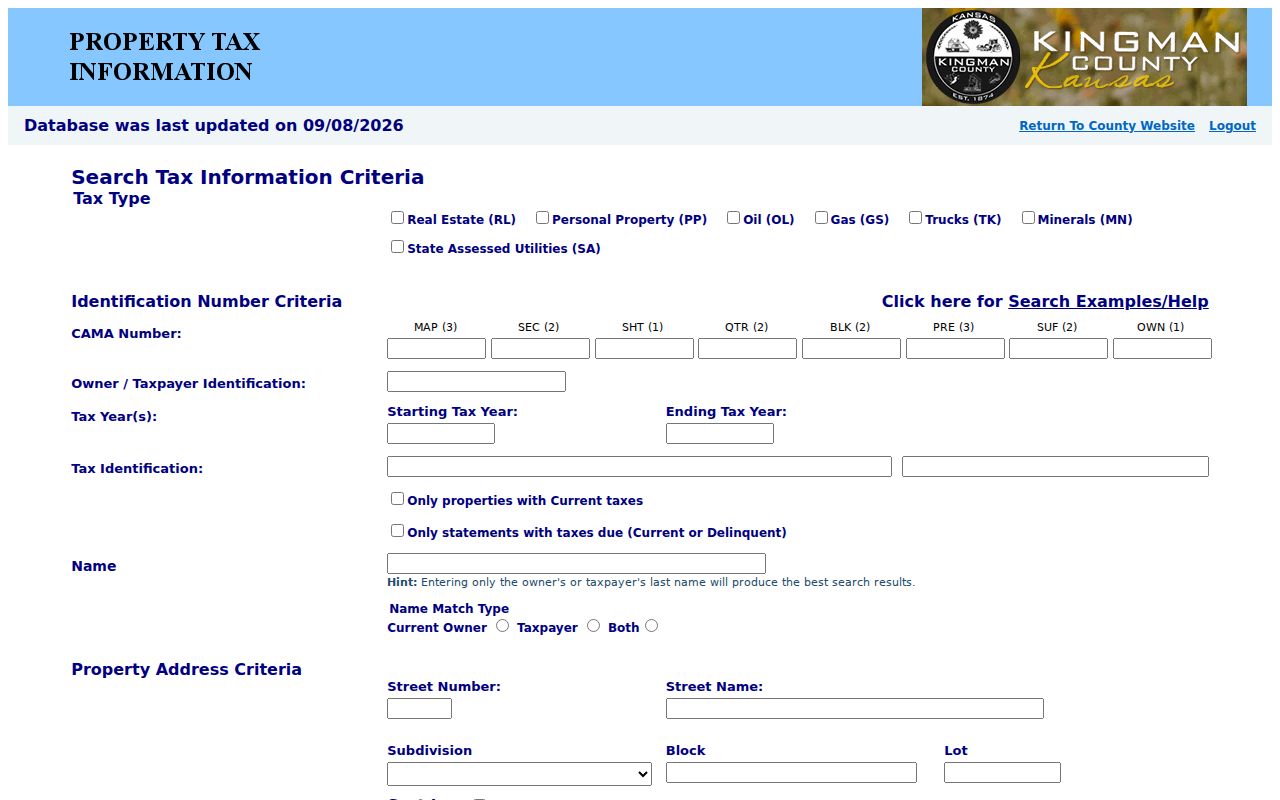
The form shows why the tax type, owner match mode, and legal-location fields matter. Save those details with each Kingman County tax result.
Trace a Kingman County Tax Bill From Parcel to Year
Names repeat in Kingman County tax rolls. Save the exact criteria used. The Tax Information Module instructions confirm both current and tax-history routes, though the module publishes no online history cutoff or exact statement field list.
- Select Real Estate and begin with the street number and street name, or enter the exact parcel and tax unit identifiers.
- If the address fails, use the owner surname, subdivision with block and lot, or section, township, and range.
- Set a starting and ending tax year only when a bounded history is needed, then note whether current-tax or taxes-due filters were active.
- Save the query date, tax type, owner-versus-taxpayer mode, and parcel description before comparing the Appraiser record.
- Assessed value
- The value to which levies apply after the statutory classification percentage.
- Mill levy
- A rate used with assessed value to calculate property tax, not the assessment percentage itself.
- Appraised value
- The county valuation before the assessment percentage; agricultural land instead uses economic-use value.
- Tax lien
- A claim tied to unpaid tax that must be checked in the proper tax, court, and recorded-instrument sources.
Kansas Percentages Shape Kingman County Assessments
Kansas law applies different percentages to different parcel classes. K.S.A. 79-1439 sets residential property and mobile homes at 11.5 percent. Vacant lots and nonprofit property sit at 12 percent. Commercial or industrial property and agricultural improvements sit at 25 percent. Public utilities sit at 33 percent. Most other property sits at 30 percent. Agricultural land uses 30 percent of its economic-use value.
The distinction matters in Kingman County. Agricultural use value can fall below an ordinary market estimate. Applying 30 percent to a guessed sale price will not reproduce the county calculation. Kansas's property valuation explanation shows why appraised or use value, assessed value, and the tax levy must stay separate stages.
For a simple example, a $100,000 residential appraised value yields $11,500 assessed at 11.5 percent. The same commercial value yields $25,000 at 25 percent. Those state examples explain the math only; they are not figures for a specific Kingman County parcel.
Owner and Taxpayer Are Separate Kingman County Searches
The Name Match Type field is a built-in caution. Not every billing name proves title. Searchers can pick Current Owner, Taxpayer, or Both. A taxpayer is simply the person or entity receiving the statement. The current owner display is working roll data, so check it against the newest recorded deed.
When the two names differ, preserve the mode used. Compare parcel number, legal description, situs, and tax year. Never assume the mailing address is where a person lives. Trusts, estates, joint owners, and business entities can all create valid gaps between owner, taxpayer, mailing destination, and property address.
Note: The public CAMA result card was not captured, so do not assume unverified owner, exemption, sale, or payment labels appear online.
The Kingman County Tax Roll Changes Over Time
The Appraiser reviews sales and local economics each year. Ownership, parcels, maps, and classifications all stay under maintenance. County portal language says the data and maps come from sources subject to constant revision. A result is a dated view of a working roll, not a permanent certificate.
The tax module displays its own database update date. Record the date shown when you search. Later corrections, deed postings, valuation work, or payments can change what appears. That date is an observation, not the start or end of tax-record coverage.
The county is also moving to a newer CAMA portal with separate registered and public-user paths. A changed sign-in page does not mean the property tax records vanished. Use the official Appraiser page for the current link. Call the office if public access fails.
Delinquent Kingman County Property Tax Needs a Cross-Check
The Kingman County tax search form includes a filter. It covers statements with current or delinquent taxes due. Treat any match as a lead. It is not proof that a tax sale closed. It is also not proof that the owner of record changed. Kansas delinquency runs through statutory lists and published notice. Sometimes a district-court case comes first before title shifts. K.S.A. 79-2302 and 79-2303 set out the delinquent real-property list and its publication. K.S.A. 79-2801 covers county-bid property and later court action. So confirm the amount and stage with the county tax custodian first. Then chase the published notice and the case file. Also chase the recorded deed or instrument tied to that parcel number. One status flag never tells the whole story.
A blank result under that filter does not mean the parcel is a ghost. The year, tax type, spelling, and status filters can each hide a perfectly valid record.
Contest a Kingman County Assessment on the Kansas Calendar
Kansas Department of Revenue guidance puts valuation notices in owners' hands by March 1. From there the clock moves fast. You get 30 days for an equalization appeal. The informal meeting must happen by May 15. A final determination follows by May 20. A further appeal to the Kansas Board of Tax Appeals is due within 30 days of that informal decision. Check the exact dates and the governing statute for the tax year you care about.
Good evidence points at one parcel, not a general grievance. Identify the disputed classification or value. Keep the valuation notice and parcel description. Gather photographs or condition facts along with comparable sales that truly match. Remember that the Kingman County Appraiser's annual review controls the tax roll. Your own estimate, or even a recent sale price, does not override it.
Protect the appeal date. Read the notice as soon as it arrives and confirm the current filing route with the Kingman County Appraiser or Kansas Board of Tax Appeals.
Access Kingman County Property Tax Records Online or at the Courthouse
Online tax-record access starts with the tax form and the CAMA public-user route. Dynamic systems stall sometimes. When that happens, the Kingman County Appraiser sits at 130 N. Spruce, Kingman, Kansas, and answers the phone at 620-532-5119. The office is open Monday through Friday, 8 a.m. to 5 p.m. Staff there can walk you through the county's parcel and valuation records.
Need a specific public record the portal does not reach? The Kansas Open Records Act offers a written request route. KORA entitles you to inspect or copy non-exempt records. The county does not have to build a custom report. It does not have to run broad research for you. Name the parcel, the tax year, the record type, and the format you want. Some response is due by the third business day. Production can lag when fees, redaction, or closed material come into play.
A recorded tax lien or an ownership change is a different question. That belongs with the Kingman County Register of Deeds. It is not part of the tax search alone. The Register of Deeds allows in-person inspection and identified-copy requests. Title research, though, is yours to arrange.