
Kingman County Value Types Compared
Value labels answer different questions. A deed, meanwhile, may carry a sale or consideration figure with its own context. Always read the source and year beside each number.
| Value | What It Is | Where |
|---|---|---|
| Appraised value | County valuation label used before the class percentage | Appraiser or parcel record |
| Assessed value | Appraised or use value multiplied by the Kansas assessment percentage | County valuation and tax record |
| Agricultural use value | Economic-use basis for qualifying agricultural land | Appraiser under Kansas rules |
| Recorded sale consideration | A transaction figure that needs deed context | Recorded instrument or verified sale field |
Different classes of real estate carry different assessment rates in Kingman County. K.S.A. 79-1439 sets residential property at 11.5 percent of appraised value. Commercial and industrial parcels are higher. They use 25 percent. Agricultural land works differently still, assessed at 30 percent of its use value, which can fall well below ordinary market value. Knowing a parcel's classification comes first. Without it, comparing two assessed values from the property records invites confusion rather than insight.
Kansas Percentages Shape Assessed Value
The Kansas Department of Revenue valuation explanation keeps the three pieces separate: appraised value, assessed value, and tax rate. The class percentage is not the mill levy. It is not a market discount either. It simply converts the correct valuation base into assessed value.
The state slide lays out that conversion from appraised value to assessed value:
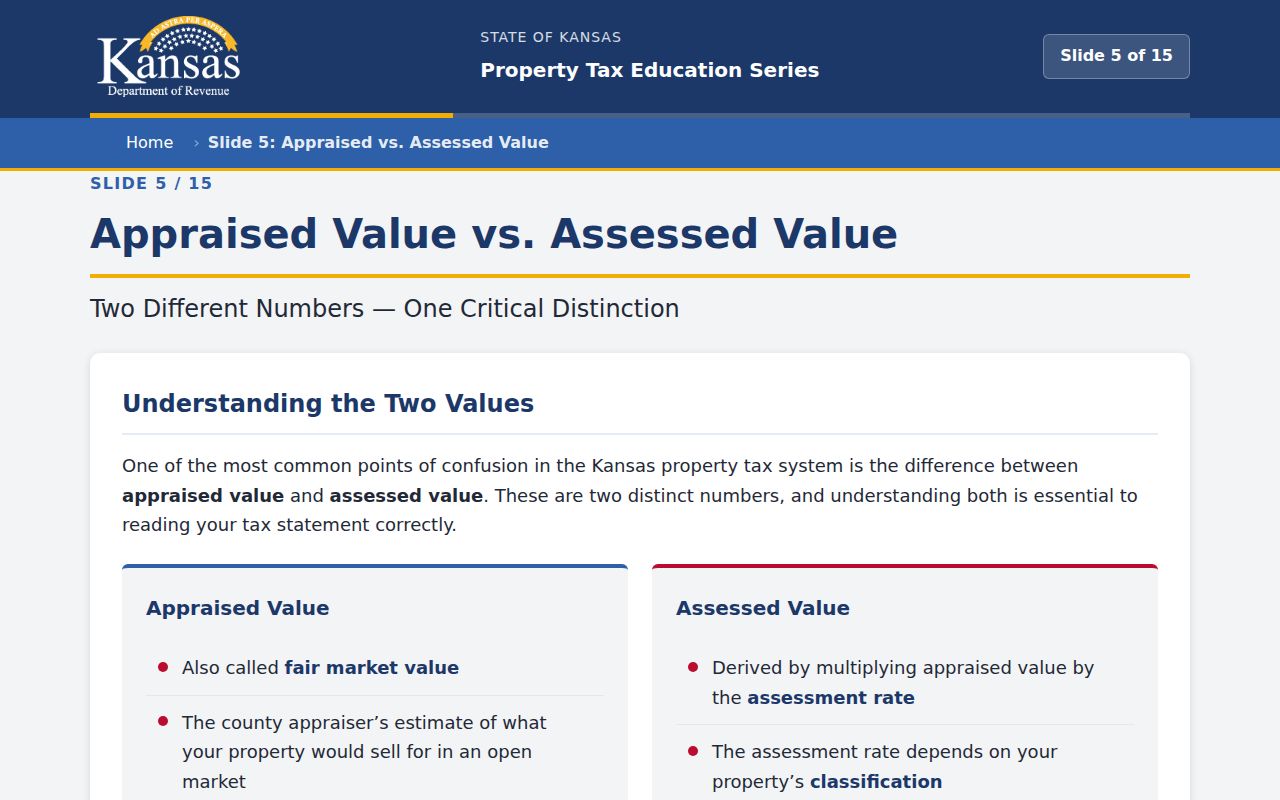
That slide is a statewide rule. It is not a Kingman County parcel result, and other Kansas classes carry their own percentages. Never apply the residential rate to a commercial parcel, mobile home, utility record, or agricultural use value without confirming the classification first.
Agricultural Kingman County Value
Agricultural land gets valued by its economic use. The assessment is 30 percent of that use value. In Kingman County, comparing that figure with a home sale price is especially misleading. A low use value is not a sale forecast. The land would not necessarily trade at that number. Record the land classification and the exact field label, and if improvements appear separately, preserve the split instead of blending everything into a guessed market total. The 30 percent applies to use value only.
Kingman County Roll Changes
Values move every year. The Appraiser reviews sales and economic conditions annually, and the county portal data is revised continuously. The tax and CAMA hosts carry dynamic update dates. That timestamp is not a valuation year. For a fair comparison, record the query date, tax year, parcel ID, class, and each exact value label. A later screen may change as the working roll is equalized or corrected, so preserve both records rather than overwriting the older one.
Sale Price Needs Deed Context
A sale field in CAMA, where displayed, is only a lead. The recorded instrument settles it, so check for parties, date, legal description, and consideration context. Some transfers are not open-market sales. Estate and entity transfers skew the picture. Kingman County publishes no online deed index. The Register of Deeds can inspect or copy identified records when supplied with parties, instrument type, reference, and tract.
Find Kingman County Assessed Value
Start from the county Appraiser page. The CAMA public entry hosts the parcel detail. Because parcel cards vary, report only the fields visible on the live result and leave absent labels marked unknown.
- Search the address and confirm the returned parcel ID and legal description.
- Record the tax year, classification, and exact appraised, use, land, improvement, total, or assessed labels actually shown.
- Use the class percentage to understand the relationship, not to invent a missing value.
- Check a sale lead against the recorded deed and its transaction context.
- Assessed value
- The valuation base after the statutory class percentage is applied.
- Appraised value
- The county's valuation label before that percentage.
- Assessment ratio
- The class percentage linking the two.
- Reassessment
- A new valuation review, not a private appraisal.
The public tax search also locates records by owner, address, parcel, subdivision, block and lot, or rural legal location. Select Real Estate.
Land and Improvement Value Gap
A parcel card can carry many components. Land value, improvement value, totals, exemptions, sale data, and history fields may appear on one. Not every field shows online. Ask the Appraiser when a needed component is absent. A building permit may explain a physical change, but permits and county valuation remain separate records, and a permit does not prove the value treatment.
GIS Does Not Set Property Value
ORKA layers parcel context, imagery, roads, and CAMA-related data into one map. The polygon and aerial view help identify the tract. They do not establish value. Map labels should lead back to dated records. For the tax bill, exemptions, or an appeal route, use the Kingman County property tax records resource, and keep valuation meaning separate from payment status.
Classification Changes Value Comparisons
Start any comparison with a question. Do these parcels share a class? Do they share a valuation basis? Residential, commercial and industrial, agricultural, mobile-home, and utility property do not all use one Kansas percentage. The county tax search lists Real Estate beside Personal Property, Oil, Gas, Trucks, Minerals, and State Assessed Utilities. The wrong type puts unrelated numbers beside the parcel. Use the exact classification as displayed, or confirm it with the Appraiser, and compare the same tax year and the same value label. Never set an assessed value from one class against an appraised value from another. When a class looks wrong, ask the Appraiser. A tax-payment screen cannot correct the underlying valuation record.
Kingman County Value Audit Trail
Save a value only with its paper trail. Note the Kingman County source, the parcel number, the legal description, the tax year, the property class, and the exact label on the screen. Capture the amount and the query date too. Some screens split the figure into land, improvement, and total fields. Keep all three. Other screens show no split. Mark those fields absent. Never estimate the land and improvement shares, since a guessed split breaks the audit trail. Portal update text, such as a dynamic tax-module date, reflects database freshness at the moment of access. A later visit may show another date. A solid note names the reading date and the active filters, and it keeps a deed's consideration tied to that deed rather than posing as a market opinion.
Note: A portal update date shows when the database was refreshed, not when the parcel itself was valued.
Kingman County Valuation Sources Differ
Four custodians answer different parts of the value question. The Kingman County Appraiser discovers, lists, classifies, and values real property, personal property, and oil or gas interests. Its staff reviews recent sales and local economic conditions each year for equalization. The tax module helps locate a year and parcel. The Register holds the conveyance that gives a sale figure its party and tract context. The Kansas Department of Revenue supplies other pieces.
Keep the custodian beside every figure. A county roll label is not a private market opinion. A deed amount is not the county's current valuation work either. State law fixes the class percentages. It does not say which class a specific Kingman County parcel falls in. For that, check the parcel record or the Appraiser.
When a current roll clashes with an older saved result, ask which year, class, or revision each screen represents. Counties review annually and revise constantly. A dated record can still be accurate for its own moment even after a later county entry changes.
Kingman County Value Has Limits
Assessed value exists to support taxation. It does not say what a willing buyer will pay, settle a boundary, prove title, or replace a parcel-specific appraisal. A recorded sale is one deal, not today's price.
Value is not price. Kingman County assessed value is a tax figure, not a sale forecast or appraisal. Use a qualified appraiser for a current market opinion.
Name the source, field, class, year, and query date every time. This habit prevents the most common value error: a correct number placed in the wrong category.